Installation Instructions
- On this page:
Tool List |
Disassembly |
Inspection |
Assembly |
Tooth Nomenclature |
Patterns |
Break In
Please read completely before beginning.
You can expect many years and many
miles of dependable use from your differential if it is
set up properly and if you use only top quality parts.
You already have quality parts if you bought them from
West Coast Differentials. By following these instructions
carefully, you will achieve proper set up. We have
successfully set up thousands of differentials without
using a pinion depth setting tool. We sincerely hope that
these instructions are helpful.
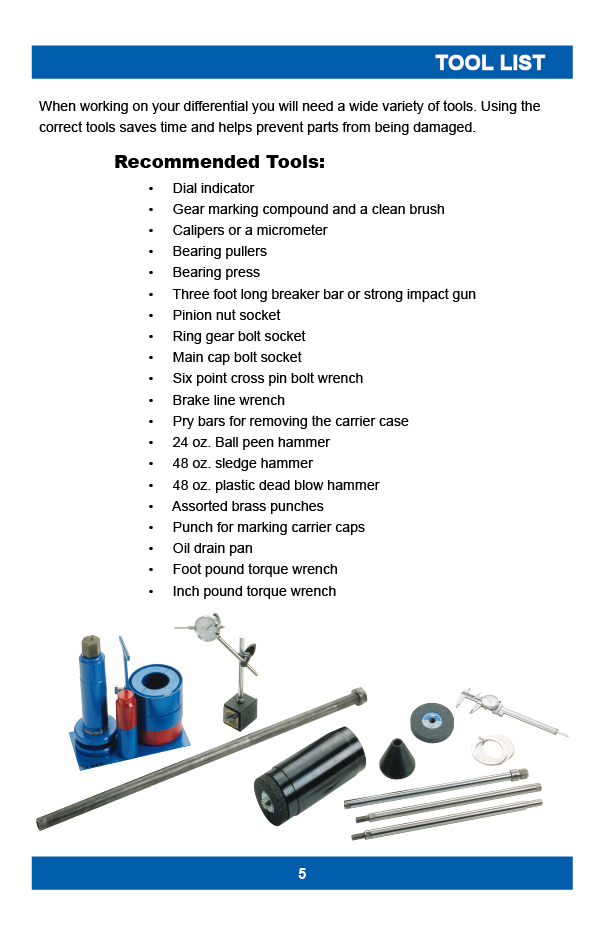
Tool List
When working on your differential
you will need a wide variety of tools. Using the correct
tools saves time and helps prevent parts from being
damaged. Here is a list of some of the tools that you may
need:
- Dial indicator
- Gear marking compound and a clean brush
- Calipers or a micrometer
- Bearing pullers
- Bearing press
- Three foot long breaker bar or strong impact gun
- Pinion nut socket
- Ring gear bolt socket
- Carrier cap bolt socket
- Six point cross pin bolt wrench
- Brake line wrench
- Pry bars for removing the carrier case
- 24 oz ball pein hammer
- 48 oz sledge hammer
- 48 oz plastic dead blow hammer
- Assorted brass punches
- Punch for marking carrier caps
- Oil drain pan
- Foot pounds torque wrench
- Inch pounds torque wrench
Back to Top
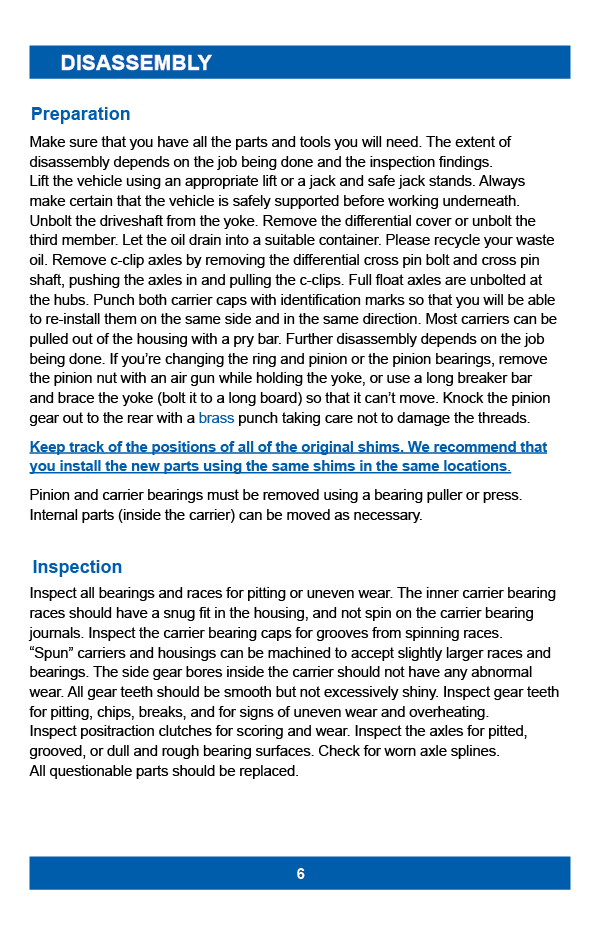
Disassembly
Make sure that you have all the
parts and tools you will need. The extent of disassembly
depends on the job being done and the inspection
findings. Lift the vehicle using an appropriate lift or a
jack and safe jack stands. Always make certain that the
vehicle is safely supported before working underneath.
Unbolt the driveshaft from the yoke. Remove the
differential cover or unbolt the third member. Let the
oil drain into a suitable container. Please recycle your
waste oil. Remove c-clip axles by removing the
differential cross pin bolt and cross pin shaft, pushing
the axles in and pulling the c-clips. Full float axles
are unbolted at the hubs. Punch both carrier caps with
identification marks so that you will be able to
re-install them on the same side and in the same
direction. Most carriers can be pried out of the housing
with a pry bar. Further disassembly depends on the job
being done. If you’re changing the ring and pinion
or the pinion bearings, remove the pinion nut with an air
gun while holding the yoke, or use a long breaker bar and
brace the yoke (bolt it to a long board) so that it
can’t move. Knock the pinion gear out to the rear
with a brass punch, taking care not to damage the
threads. Keep
track of the location and thickness of all of the
original shims.
Pinion bearings must be pressed off. Carrier bearings can
be pulled using a bearing puller. Internal parts (inside
the carrier) can be removed as necessary.
Back to Top
Inspection
Inspect all bearings and races for
pitting or uneven wear. The inner carrier bearing races
should not spin on the carrier journals. The carrier
races should have a snug fit in the housing. Inspect the
carrier race bores for grooves from spinning races. The
side gear bores inside the carrier should not have any
abnormal wear. All gear teeth (including the spider
gears) should be smooth but not excessively shiny.
Inspect all gear teeth for pitting, chips, breaks, and
for signs of uneven wear and overheating. Inspect
positraction clutches for scoring and wear. Inspect the
axles for pitted, grooved, or dull and rough bearing
surfaces. Check for worn axle splines. All questionable
parts should be replaced.
Back to Top
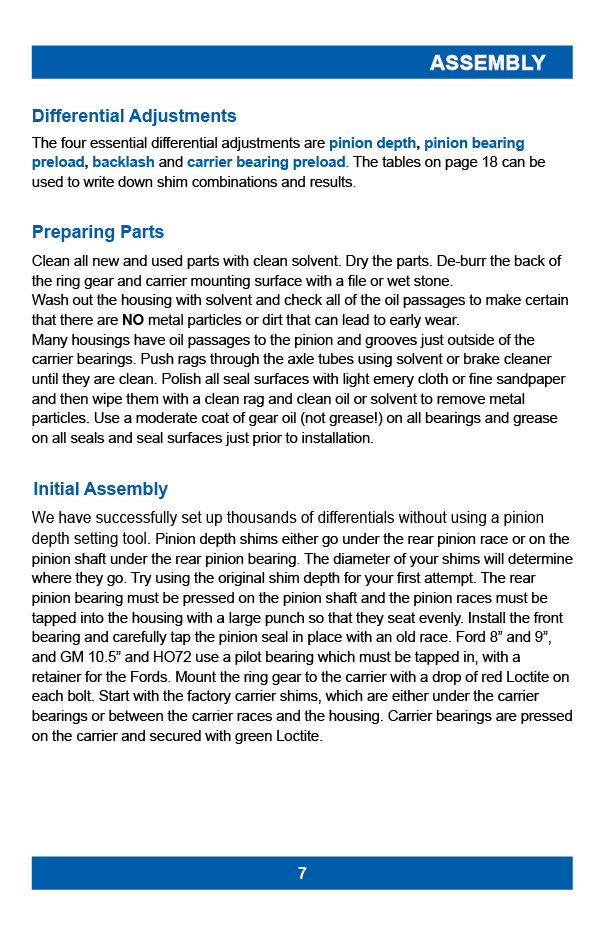
Assembly
The four essential differential
adjustments are pinion depth, pinion bearing preload,
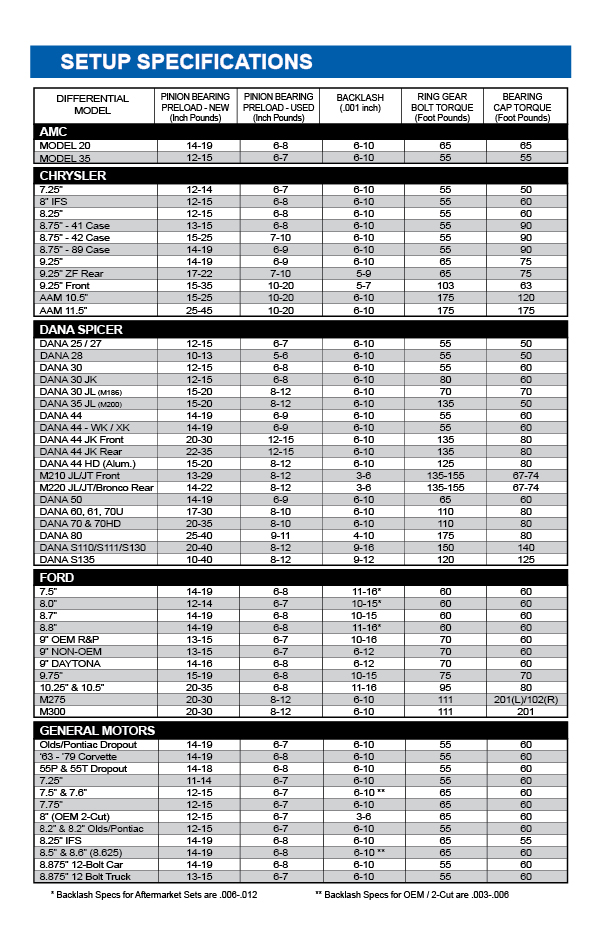
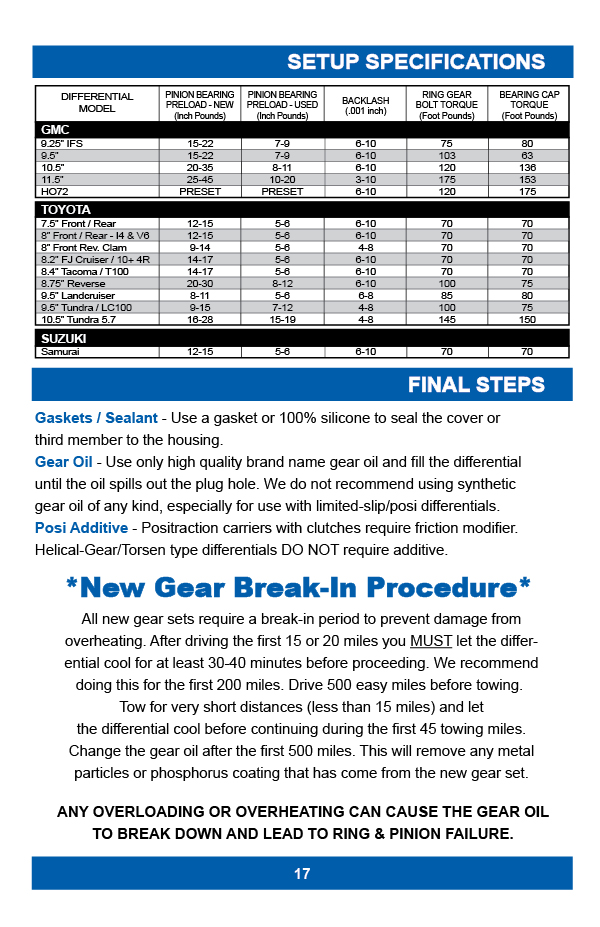
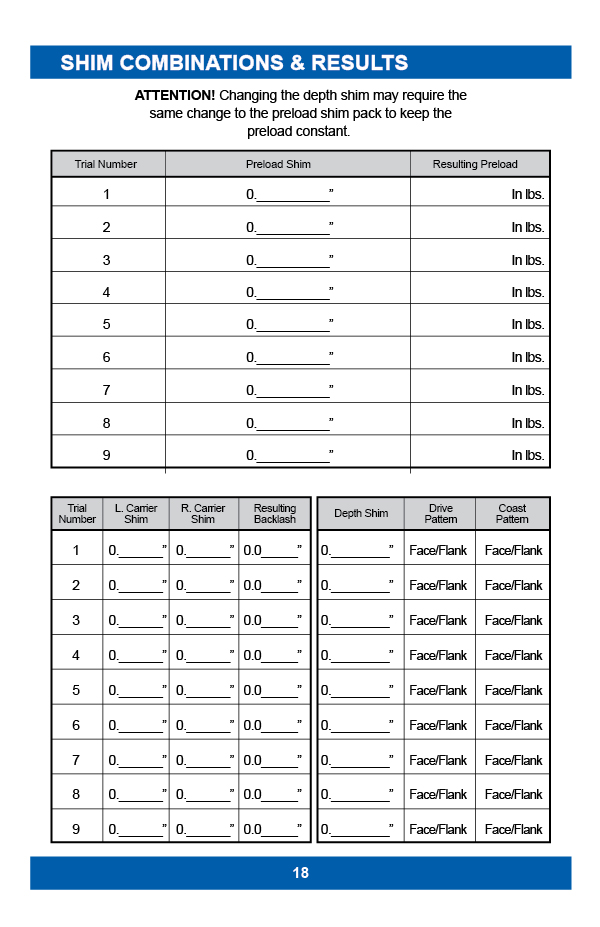
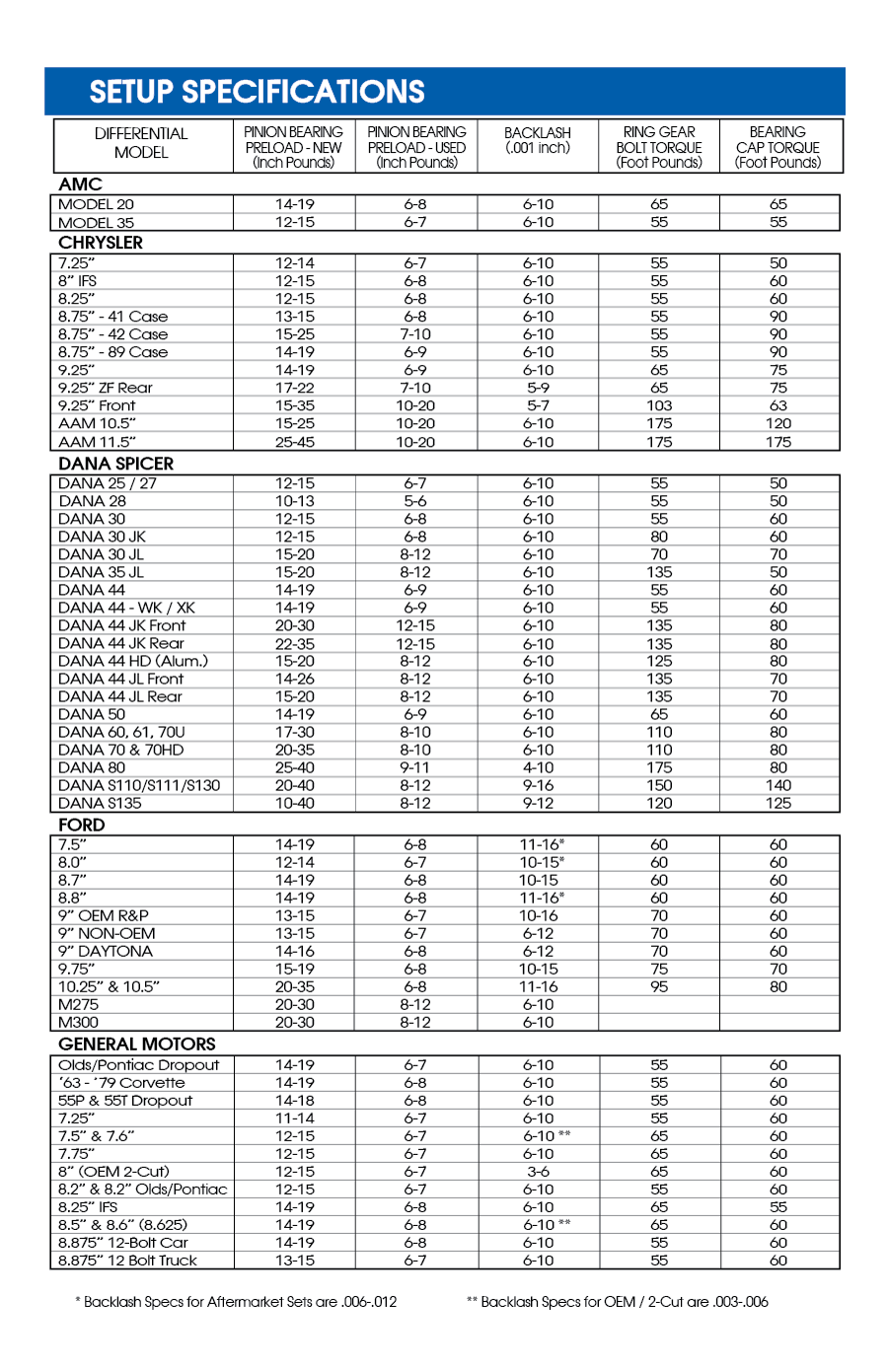
backlash and carrier bearing preload. The tables at the
back can be used to write down shim combinations and
results.
Clean all new and used parts with
clean solvent. Dry the parts. De-burr the back of the
ring gear and carrier mounting surface with a file or wet
stone. Wash out the housing with solvent and check all of
the oil passages for metal particles or dirt that can
lead to early wear. Many housings have oil passages to
the pinion and grooves just outside of the carrier
bearings. Push rags through the axle tubes, using solvent
or brake cleaner until they are clean. Polish all seal
surfaces with light emery cloth or fine sandpaper and
then wipe them with a clean rag and clean oil or solvent
to remove metal particles. Use a moderate coat of gear
oil (not grease!) on all bearings and grease (not oil) on
all seals and seal surfaces just prior to installation.
Pinion depth shims either go under
the rear pinion race or on the pinion shaft under the
rear pinion bearing. The diameter of your shims will
determine where they go. Try using the original shim
depth for your first attempt. The rear pinion bearing
must be pressed on the pinion shaft and the pinion races
must be tapped into the housing with a large punch so
that they seat evenly. Install the front bearing and
carefully tap the pinion seal in place with an old race.
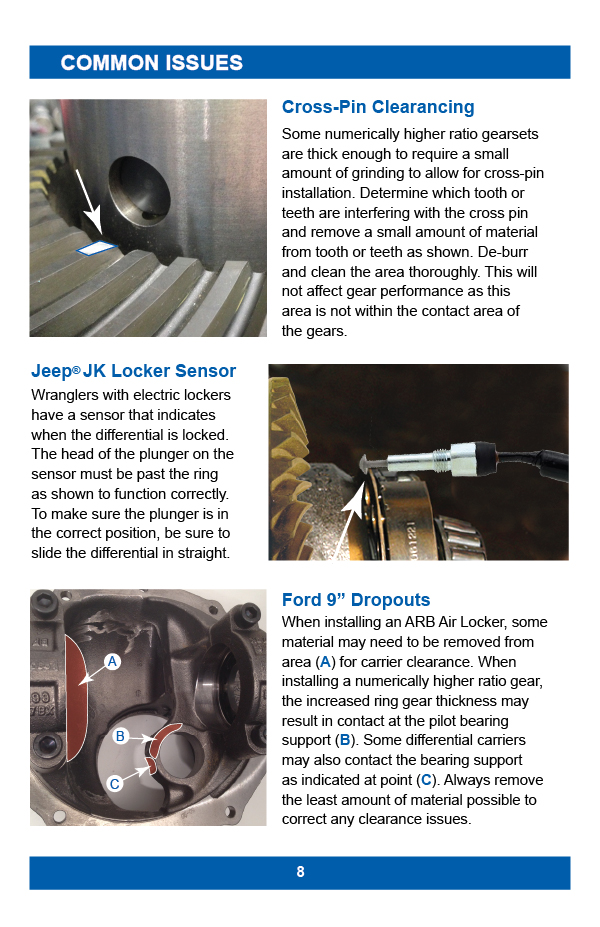
Ford 8" and 9", and GM 10.5" and
12.25" use a pilot bearing which must be tapped in,
with a retainer for the Fords. Mount the ring gear to the
carrier with a drop of red Loctite on each bolt. Carrier
bearings are pressed on the carrier and secured with
green Loctite. Note that in Dana Spicer differentials the
carrier shims go between the carrier and carrier
bearings. Again, try using the original shim
configuration.
Pinion bearing preload is measured
in inch-pounds, and is a measure of the rolling
resistance of the pinion bearings after proper torque has
been applied to the pinion nut. Set the preload carefully
(see "Set Up Specifications") so that the
bearings will have a long life. Use oil on the pinion nut
washer surface during all assemblies and red Loctite on
the pinion nut threads during the final assembly.
Crush Sleeve Design:
If you are unsure about
getting the correct pinion depth, it may be easier to
install the pinion without a crush sleeve until
the correct pinion depth has been established. Always use a
new crush sleeve for final assembly. Slide the crush sleeve
on the pinion shaft (unless you are using the trial
and error method) and install the pinion through the rear of
the housing. The yoke usually must be tapped on while
applying pressure on the pinion gear head to hold it in place.
Use an impact wrench or huge breaker bar to apply the
torque necessary to crush the sleeve. Proceed very slowly
so that you don’t overload the bearings. The pinion
preload will be zero until the bearings contact the races
but will then increase very quickly. Use an inch-pound
torque wrench to check the preload. If the pinion bearing
preload exceeds the specified allowable range, install
another new crush sleeve and start over.
Preload Shim Design: Clean
the shims completely so that there are no particles that
may cause a false preload reading or cause the shim stack
to change thickness over time as the vehicle is driven.
Slide the shim pack over the pinion shaft to the shelf.
Use the original shims on the first assembly or add
0.003" to the original preload shims to make up for
the bearings settling into the housing. Tighten the
pinion nut to approximately 250 foot pounds. Go slowly so
as not to damage the bearing if the preload shim stack is
not thick enough. Use an inch-pound torque wrench
to check the preload. If the preload is too loose then
remove shims so that the bearings will be tighter against
the races and increase the preload. If the preload is too
tight then remove the pinion gear and add shims so that
the bearings will not be as tight against the races.
All Designs: After
reaching the correct preload, moderately tap both ends of
the pinion to seat the bearings, races and yoke. Be
careful not to hit the pinion so hard that it damages the
bearings. After "seating" the pinion, check the
pinion bearing preload again.
Carrier bearing preload is not
specifically measured, but a good tight fit is important
in all differential designs. Inadequate carrier bearing
preload allows the carrier to move when under load and
this can cause the backlash to open up. Check the
backlash by mounting a dial indicator to the housing with
the plunger set perpendicular to the ring gear teeth.
Hold the pinion yoke and rotate the ring gear back and
forth. See the specifications section. The backlash will
generally change about 0.007" for each 0.010"
that the carrier is moved. To decrease the backlash, move
the carrier closer to the pinion centerline. To increase
the backlash, move the carrier away from the pinion
centerline.
Screw Adjuster Design: Oil the
adjuster threads on both the housing and on the adjusters
themselves. While holding the races on the bearings,
place the carrier in the housing. Install the carrier
caps according to the marks made during disassembly so
that the threads are seated evenly on the adjusters.
Third member differential designs require a 10 to 12 inch
spanner wrench to tighten the adjusters. Chrysler
differential designs require an extension bar and special
spanner to access the adjusters through the axle tubes.
Tighten both the left and right adjusters evenly by hand
until they are fairly tight. If the backlash is too wide,
tighten the left adjuster until the backlash is correct.
If the backlash is too tight, tighten the right adjuster
until the backlash is correct. If necessary, open one
adjuster and tighten the other. Both adjusters must be
fully hand tightened when acceptable backlash is
obtained. The final adjustment should tighten the left
adjuster since the ring gear is forced away from the
pinion gear while under load.
Shim Design: Some
differentials use shims between the carrier bearing races
and the housing and some use shims between the carrier
bearing and the carrier case. Carrier bearing preload is
established by the tightness of the shims. The carrier
should be shimmed tight enough that it must be tapped in
with a plastic dead blow hammer. While holding the races
on the bearings (and outside shims on the races) start
the carrier into the housing and tap it in with the
hammer. Install the carrier caps according to the marks
made during disassembly. Check the backlash. If the
backlash is too wide, move or add shims to the left side.
If the backlash is too tight, move or add shims to the
right side. (If the carrier is snug, move and replace the
same thickness; if the carrier is too tight or too loose,
remove or add shims accordingly.)
Back to Top
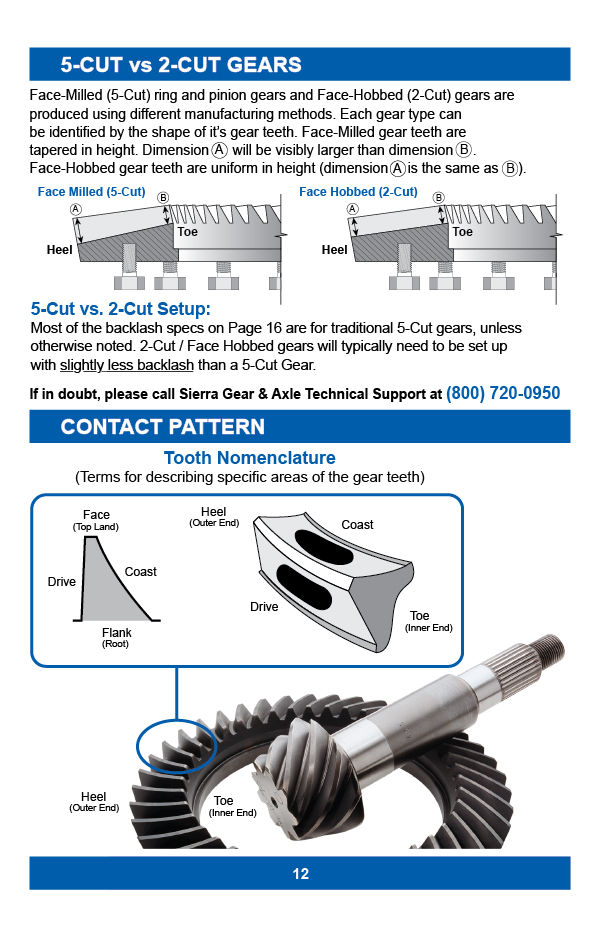
Tooth Nomenclature
(Terms for describing specific areas of the gear teeth)
|
|
Back to Top
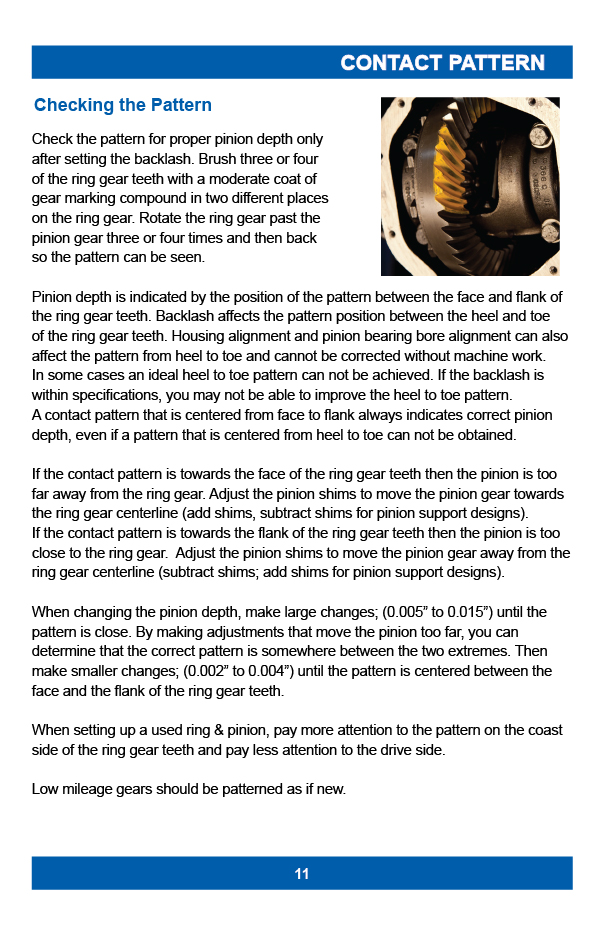
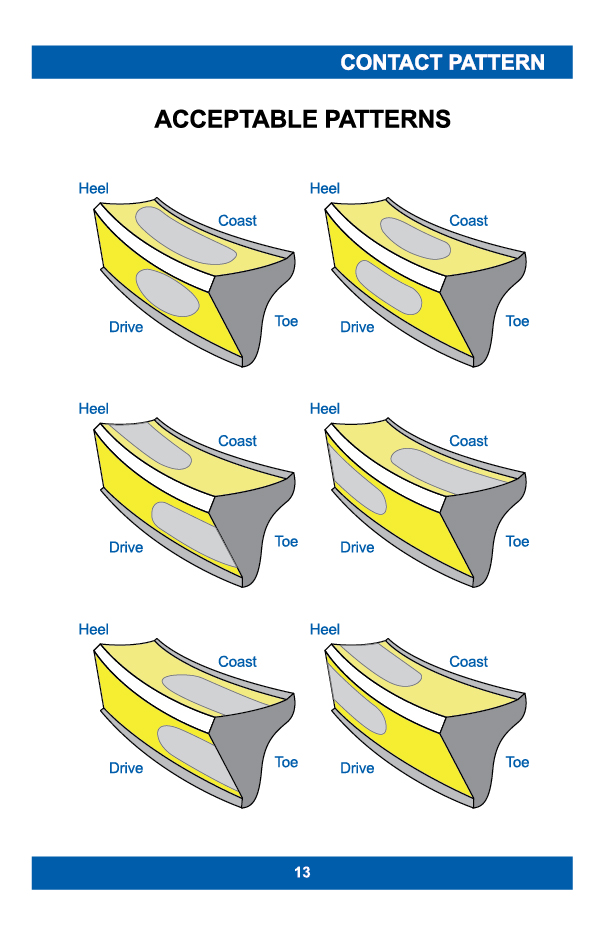
Checking the Pattern
Check the pattern for proper pinion
depth only after setting the backlash. Brush three or
four of the ring gear teeth with a moderate coat of gear
marking compound in two different places on the ring
gear. Rotate the ring gear past the pinion gear three or
four times and then back so the pattern can be seen.
Pinion depth is indicated by the
position of the pattern between the face and flank of the
ring gear teeth. Backlash must be kept within
specifications, and will therefore only slightly affect
the pattern between the heel and toe of the ring gear
teeth. Housing alignment and pinion bearing bore
alignment can also affect the pattern from heel to toe
and can not be corrected without machine work. In some
cases an ideal heel to toe pattern can not be achieved.
If the backlash is within specifications, you may
disregard the heel to toe pattern. A contact pattern that
is centered from face to flank always indicates correct
pinion depth even if a pattern that is centered from heel
to toe can not be obtained.
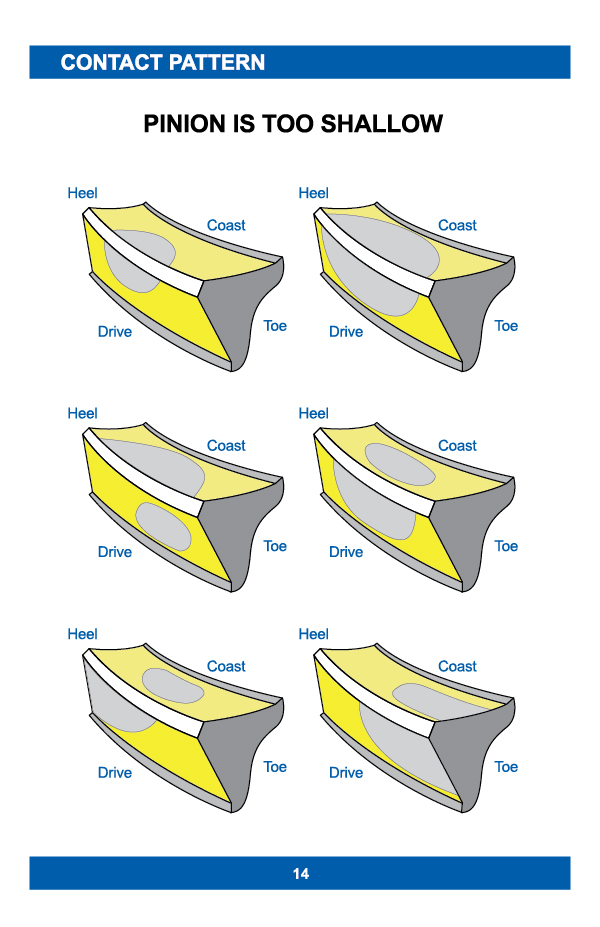
If the contact pattern is towards
the face of the ring gear teeth then the pinion is too
far away from the ring gear. Adjust the pinion shims to
move the pinion gear towards the ring gear centerline
(add shims; subtract shims for pinion support designs).
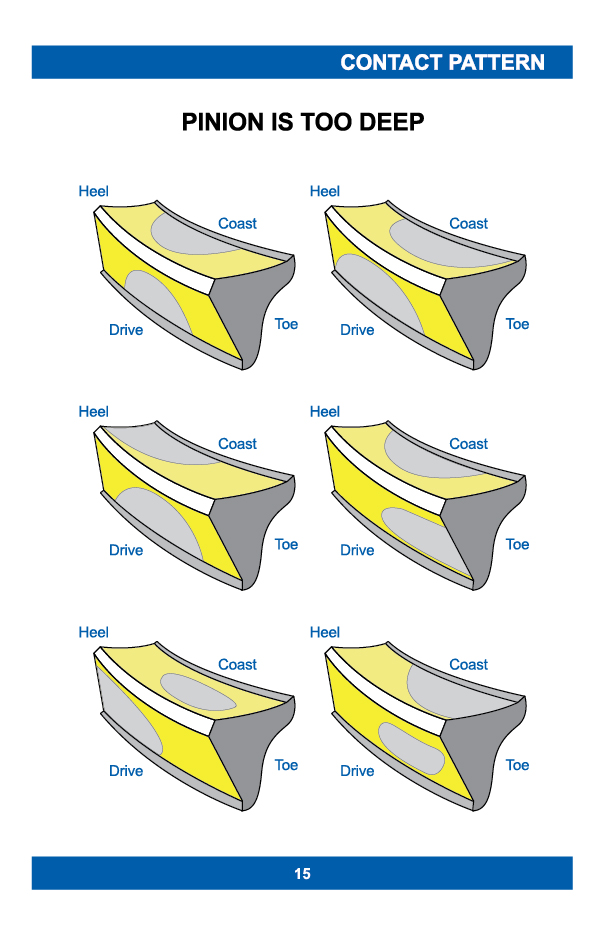
If the contact pattern is towards the flank of the ring
gear teeth then the pinion is too close to the ring gear.
Adjust the pinion shims to move the pinion gear away from
the ring gear centerline (subtract shims; add shims for
pinion support designs).
|
 |
 |
| Acceptable
Contact Pattern - Click to see larger image |
Pinion is too
shallow - Click to see larger image |
Pinion is too
deep - Click to see larger image |
When changing the
pinion depth, make large changes (0.005" to
0.015") until the pattern is close. By making
adjustments that move the pinion too far, you can
determine that the correct pattern is somewhere between
the two extremes. Then make smaller changes (0.002"
to 0.004") until the pattern is centered between the
face and the flank of the ring gear teeth.
When setting up a used ring &
pinion, pay more attention to the pattern on the coast
side of the ring gear teeth and pay less attention to the
drive side. Low mileage gears should be patterned as if
new.
Back to Top
Gear Oil, Additive and Break-In
Use a gasket or 100% silicone to
seal the cover or third member to the housing. Use only
high quality name brand gear oil and fill the
differential until the oil spills out the plug hole.
Positraction carriers require anti-friction additive.
All new gear sets require a
break-in period to prevent damage from overheating. After
driving the first 15 or 20 miles you must let the
differential cool for 30-40 minutes before proceeding.
Drive 500 easy miles before towing. Tow for very short
distances (less than 15 miles) and let the differential
cool before continuing during the first 45 towing miles.
Change the gear oil after the first 500 miles. This will
remove any metal particles or phosphorus coating that has
come from the new gear set.
ANY
OVERLOADING OR OVERHEATING CAN CAUSE THE GEAR OIL TO
BREAKDOWN AND THE RING & PINION CAN FAIL.
Back to Top
|